Initiated by Dr. Xin Wei, University of Michigan
Ongoing development by the community

Explore Open Landslide Datasets Worldwide

Browse open-access landslide datasets from different regions and communities around the world. Click on markers to view dataset details.

Large-Scale Landslide Datasets

Comprehensive large-scale (global or national) landslide datasets for research, analysis, and model development.

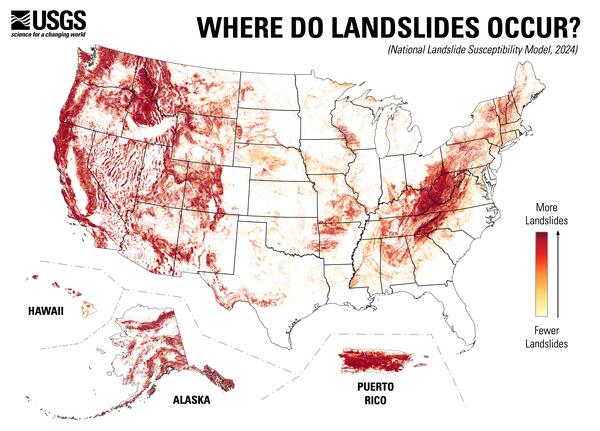
Landslide Inventories across the United States (ver. 3.0, February 2025)

Landslide Inventories across the United States (ver. 3.0, February 2025)

National Wide

A comprehensive compilation of landslide inventories across the United States, providing point and polygon data for landslide research and hazard assessment.

Records: ~1 million

Resolution: NaN

Type: point, polygon

Chinese Academy of Sciences - Landslide Dataset

Global

CAS Landslide Dataset contains 20,865 pixel-labeled RGB image patches (stored as 512×512 TIFFs) with matching label TIFFs, organized into nine regions spanning Indonesia, Japan, Haiti, and multiple sites in China. It is multi-sensor and multi-resolution (roughly 0.2–5 m), mixing commercial/remote-sensing sources (e.g., WorldView, Sentinel-2, Planet, SuperView-1, GF-1, Landsat) and UAV imagery, and it is split into multiple subdatasets with distinct acquisition times and resolutions. The paper emphasizes that applying simple quality control rules (e.g., filtering patches dominated by image boundary/blank areas, heavy cloud occlusion, or extremely small labeled landslide areas) makes training and evaluation more reliable.

Records: 20,865 RGB images

Resolution: 512 × 512 pixels, Ground Resolution is provided in m and varies

Type: polygon

HR-GLDD: Global Dataset

Global

HR-GLDD is an open benchmark for rapid landslide mapping using 3 m PlanetScope surface reflectance imagery and pixel-level binary masks, built from 10 globally distributed event sites. The dataset is prepared using four PlanetScope bands (red, green, blue, NIR) and then cropped into standardized 128×128 image patches (with corresponding mask patches). To reduce extreme class imbalance, patches containing no landslide-labeled pixels are removed, and the paper benchmarks several U-Net-style segmentation models and evaluates transfer to recent unseen events to assess cross-region generalization.

Records: 3825

Resolution: 128 x 128 pixels (spatial resolution of up to 3 m)

Type: polygon

Landslide4Sense: Reference Benchmark Data and Deep Learning Models for Landslide Detection

Global

Landslide4Sense provides 3,799 labeled image patches for landslide detection across four regions (Iburi, Kodagu, Gorkha, and Taiwan), with pixel-wise annotations. Each patch is 128×128 pixels and is a 14-band composite: Sentinel-2 bands 1–12 plus DEM and slope derived from ALOS PALSAR (bands 13–14). All bands are resampled to 10 m/pixel to align spatial resolution, and the benchmark highlights practical challenges such as strong class imbalance and cross-region variability when comparing multiple deep learning segmentation models.

Records: 4,844 image patches

Resolution: 128 x 128 pixels

Type: polygon

GDCLD: Global Dataset of Coesismic Landslide Mapping

Global

GDCLD is a globally distributed benchmark for coseismic (earthquake-triggered) landslide mapping compiled from nine seismic events using multi-source high-resolution remote sensing imagery (including PlanetScope, UAV, Gaofen-6, and MapWorld/'World Map' imagery). Landslide polygons are manually interpreted and converted into pixel-level binary masks, and the imagery is standardized (including conversion to 8-bit) before being cropped into 1024×1024 non-overlapping image patches (overlap = 0); most patches without landslide pixels are removed to mitigate imbalance. The dataset is organized at the event level with five events used for training/validation (split 75%/25%) and four independent events reserved for testing (Mesetas, Sumatra, Lushan, Palu), enabling clean evaluation of cross-event generalization.

Records: 466

Resolution: 1024 pixels x 1024 pixels Resolutions varies and there is a table in the paper with this information

Type: polygon

NASA Cooperative Open Online Landslide Repository

Global

COOLR (Cooperative Open Online Landslide Repository) is a global, open platform that merges NASA's Global Landslide Catalog (GLC) with citizen-science reports collected via Landslide Reporter and visualized/downloaded via Landslide Viewer. COOLR stores landslide information in two geodatabases (event points and event polygons) and includes structured fields such as event ID, source and link, date/time, location and location-accuracy levels, landslide category/trigger/size/setting, impacts (fatalities/injuries), and optional media (photo link) plus submission/edit metadata. In the initial 13 months, 49 contributors added 162 new events across 37 countries on five continents, demonstrating that citizen reports can meaningfully fill spatial/temporal and multilingual gaps and reach accuracy usable for global-scale susceptibility and hazard modeling.

Records: 39634

Resolution: LHASA v1 Output Resolution: ~0.1°, every 3 hours LHASA v2 Output Resolution: ~0.1°, daily

Type: polygon, point

How to Contribute Your Landslide Data

Step 1: Prepare Your Data

Ensure your data (imagery, labels, metadata) meets our required format and content standards for consistency and quality.

Kind reminder: If your dataset has not yet been published or assigned a DOI, you may consider publishing it on platforms such as DesignSafe-CI before sharing it publicly.

Step 2: Fill Out the Form

Our official submission channel is a Google Form. Please provide all necessary information accurately.

Step 3: Review and Publication

Your submitted data will be reviewed by our team. Upon approval, it will be included in our database and your contribution will be acknowledged.

The Power of Contribution

Share your open landslide datasets with the global research community to help drive collective progress in the field.

Submit New Dataset