AI for Science · Geotechnical Engineering · Geohazards
Xin Wei
Understanding and predicting geohazards by uniting AI and domain knowledge, for more resilient communities.
Eric and Wendy Schmidt AI in Science Postdoctoral Research Fellow
University of Michigan
Supported by Schmidt Sciences
Founder of TerraMosaic
3520 Green Court, Ann Arbor, MI 48105

I earned my Ph.D. in Geotechnical Engineering from Shanghai Jiao Tong University, including a period as a visiting scholar in structural engineering at the University of Illinois at Urbana–Champaign.
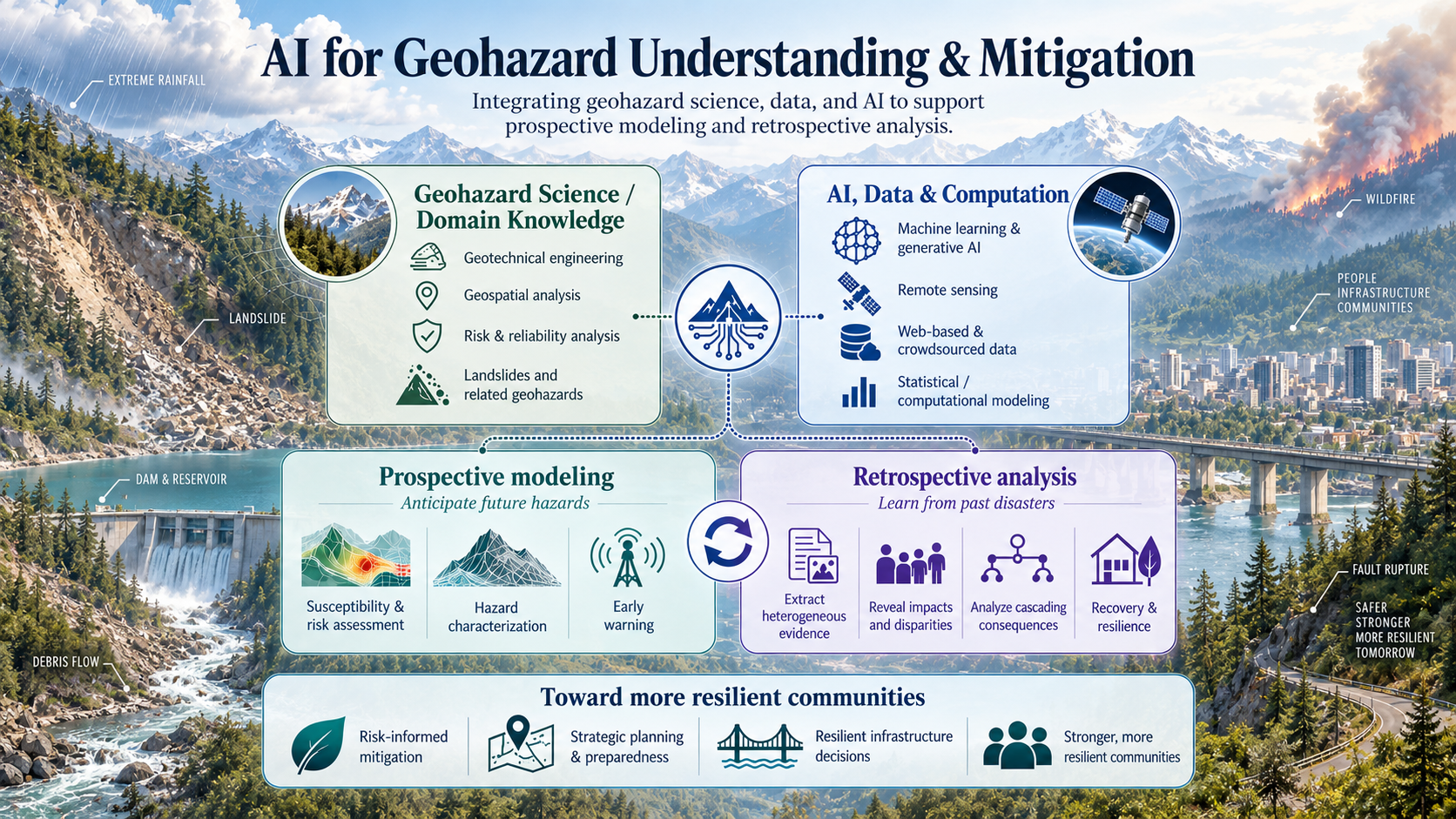
My research sits at the intersection of geohazard mitigation and AI. It advances the understanding and mitigation of geohazards by integrating domain knowledge with AI — building on expertise in geotechnical engineering, geospatial analysis, and risk and reliability analysis; leveraging the transformative potential of AI; and utilizing diverse data sources ranging from web-based and crowdsourced data to remote sensing.
My work spans prospective modeling and retrospective analysis of geohazards, with a current focus on landslides. Prospectively, I develop novel models for susceptibility and risk assessment, hazard characterization, and early warning to improve the resilience of communities facing geohazards. Retrospectively, I leverage generative AI to extract and analyze heterogeneous data to uncover how disasters have affected communities — revealing underappreciated impacts, cascading consequences, and patterns of recovery and resilience.
Ultimately, my goal is to help build more resilient communities by advancing scientifically grounded and societally relevant approaches to geohazard understanding and mitigation.
News

Latest Posts

- perspectives When Models and Agents Evolve Together: Notes from Fuli Luo Notes on Fuli Luo's interview about OpenClaw, agent training, long-context model design, and how research teams learn as their tools change.
- perspectives Building the Systems Behind AI: Notes from Heng Liao Notes on Heng Liao's discussion of Ascend, the eighteen-level pagoda, chip architecture, memory and interconnects, open source, and the discipline of building useful systems.
- perspectives How Robots Learn to Get Better: Notes from Liyiming Ke My reflections on Liyiming Ke's discussion of experience-driven robot learning, generalization, evaluation, embodiment, and the human questions raised by increasingly capable AI.
Selected Publications/Presentations

- Geosci. Front.Improving pixel-based regional landslide susceptibility mappingGeoscience Frontiers. Previously listed as an ESI Highly Cited Paper, 2024
- Acta Geotech.Comparison of hybrid data-driven and physical models for landslide susceptibility mapping at regional scalesActa Geotechnica, 2023
- Geosci. Front.Machine learning for pore-water pressure time-series prediction: Application of recurrent neural networksGeoscience Frontiers. ESI Highly Cited Paper, 2021
- Nat. HazardsA hybrid framework integrating physical model and convolutional neural network for regional landslide susceptibility mappingNatural Hazards, 2021
Gallery
Beyond the research
A few favorite moments, near and far.


Partners
Collaborating across institutions
The labs, centers, and initiatives behind my research.
Hover over a row to pause.